What It's About

This is just a spot for me to put up new ideas, new creations, and little observations from my daily life.

Sunday, February 3, 2013

Glass Etching - Tutorial


                Something I’ve found myself to be very interested in lately is glass etching.  I have tons of glass bakeware that is just plain old glassware.  I’ve decided that etching the glass would be the best way to personalize and make my bakeware more exciting.  Using a gift card from my little sister, I purchased a glass etching kit.  The only one the store had available was the Martha Stewart Glass Etching Kit, but it seemed just as good as any, so that is what I purchased.  Then I chose a plain old glass pie dish to etch.  Matt and I chose a cute design from a Cricut cartridge that we both decided would look good on the pie dish and set to work.  Below is a tutorial on how to make your own.


Step 1.  Gather your supplies.  You will need a Cricut (or your own imagination and an X-acto knife), contact or shelving paper, scissors, a card, a glass etching kit, an old paintbrush, and your glassware.

Step 2.  Clean your glassware.  Using a paper towel and a glass cleaner, be sure your glassware is clean and debris free.

Step 3.  Get your Cricut ready.  

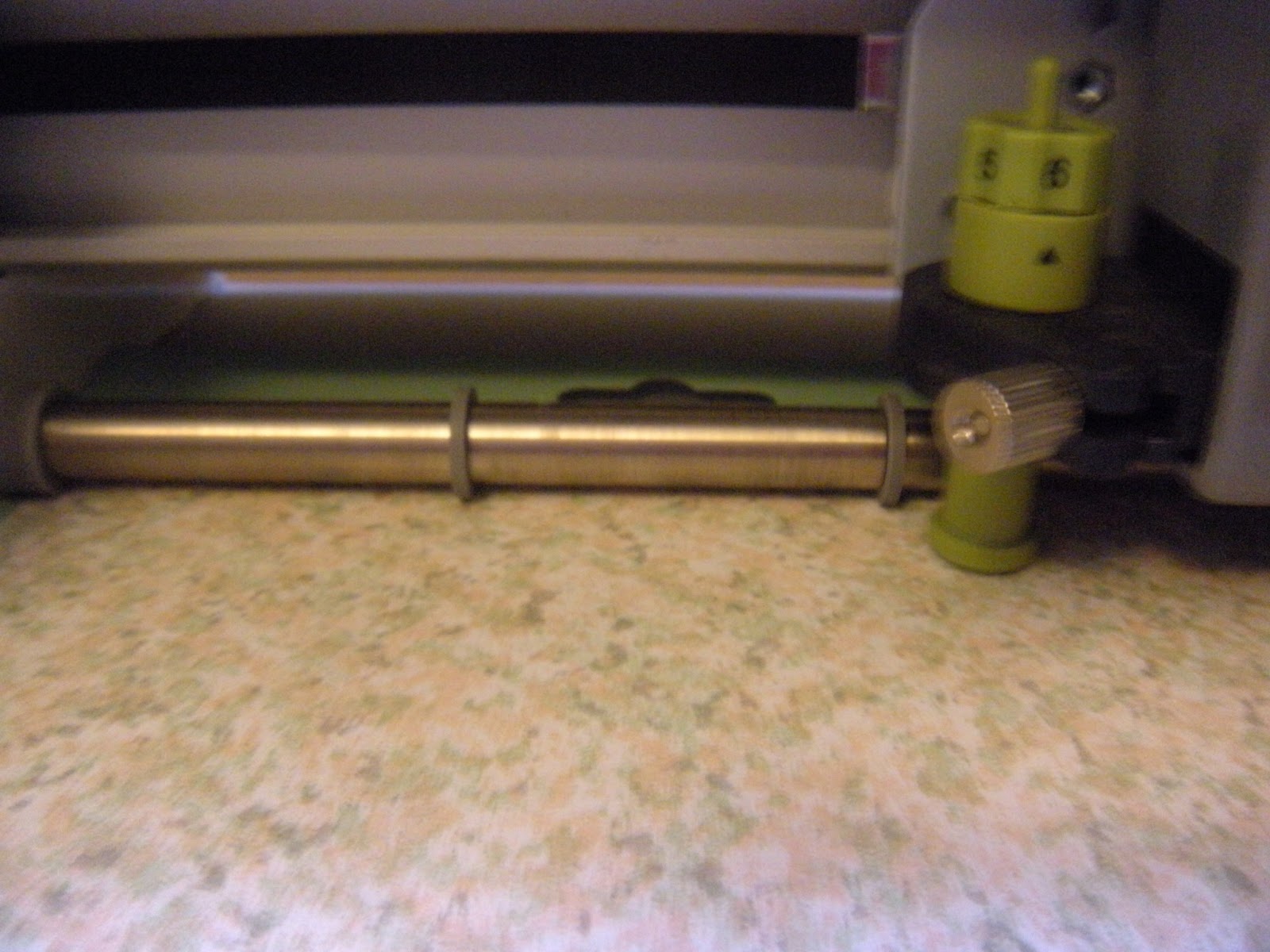
Since I was etching the entire bottom of my baking dish, I chose the 5 ½ size on the size dial.  

Contact paper is not very thick, so I chose 3 on the speed dial and 3 on the pressure dial.
 
Step 4.  Contact paper.  Cut your contact paper to the size needed for your project.  

Since I decided on a 5 ½ inch pattern, I cut my contact paper to a 6x6 inch square.  Place the contact paper right side up on a Cricut mat.

Step 5.  Cut it.  Load the paper into the Cricut.  

Choose your design, then cut it out.  


Unload you paper and there you have it.  

Remove your contact paper from you Cricut mat very carefully.

For those of you cutting with an X-Acto knife, draw your design on the contact paper, then cut it out.  Be sure to use a self-healing mat to cut on.

Step 6.  Apply Paper.  Begin applying your contact paper to the glassware by peeling back one edge and slowly pressing it to the glass surface.  

Press air bubbles out with a credit card or other tool as you go.  Make sure there are no bubble along the edge of your design as the etching liquid may get under it and ruin your design.


Step 7.  Begin etching.  Now that your contact paper is applied to the glass surface, you can begin etching.  

Add the etching liquid by using your old paintbrush over the contact paper surface.  

Use a thick, even layer.

Step 8.  Wait.  I left my etching liquid on somewhere between 15-20 minutes and it yielded beautiful results.  Have a cup of tea while you wait!


Step 9.  Remove the etching liquid.  Using a credit card, scrape away the etching liquid and put it back into the bottle of etching liquid.  


The etching liquid can be used multiple times, so make sure to conserve it.  After all, it wasn’t a cheap purchase.

Step 10.  Rinse.  Rinse off your glassware with water and a paper towel if necessary.  

Once thoroughly rinsed, dry well, remove contact paper, and wait about 2-3 minutes.  

Your etching may not look very good right after it is rinsed, but I promise, if you wait a few minutes, the water will dry entirely and your glass etching will look beautiful.  I hope you enjoy!


Saturday, February 2, 2013

My First Quilt - Tutorial


               I don’t know when it entered my mind, probably the moment I opened my sewing machine, but I was set that I would make a quilt for my Godson and another for my 2 year old cousin.  After less than 2 months with my wonderful sewing machine I can say that I have kind of successfully finished my first quilt.  There are some uneven squares due to my lack of proper tools.  Regardless of the imperfections of my quilt, I feel satisfied with it and a quite proud of the finished product.  I’ll be putting up another tutorial with my second quilt once it is finished as well.  Check out the tutorial below for how I did my first quilt.  You’ll notice there is advice and changes I would make if I were doing this over (and I am).  I hope you enjoy it and get a wonderfully beautiful quilt you can be proud of as well.


Step 1.  Choose your size.  I decided on a crib-sized quilt since I was making the quilt for a 2 year old.

Step 2.  Choose your fabric.  You will need 6 colors for the center of your quilt.  I chose 3 prints and 3 solids and asked for a quarter-yard of each.  Next I chose a coordinating color for the edging and another color for the backing.  You will need about a quarter yard for the edging and a yard and a half for the backing.  Finally, you’ll need fabric for the binding.  I got a quarter yard (this was enough for 2 quilts).  The binding fabric also was a coordinating stripe pattern that was just adorable.

Step 3.  Gather your supplies.  A word of advice, you most definitely need supplies that are proper for the work you are doing.  Later in the process I got the proper supplies, but I wish I would have invested sooner.  You will need a large self healing mat, a rotary cutter, a see-through yard stick or large ruler, an iron, pins, a quilting needle (for your sewing machine) a GOOD thread, quilting thread, and of course, your sewing machine.

Step 4.  Measure.  I measured the center of my quilt first.  I cut my squares to 5.5 inches each.  


If you are making a quilt like mine, you will need 8 squares of each fabric you chose for the center of your quilt.  Cut these using your rotary cutter and your long ruler on your self-healing mat.


Step 5.  Iron.  Iron all your little squares.

Step 6.  Choose a Pattern.  I set my squares out in a pattern prior to doing any sort of sewing.  Once I found a pattern I liked, I began pinning.


Step 7.  Pin it.  Pin your lines using your pins one row at a time.

Step 8.  Sew the rows.  Use your good quality thread and a standard needle at this point in your process.  Begin sewing one square to the next along your row until all are sewn together.  Remember to use a ¼ inch seam allowance.

Step 9.  Iron again.  Once all your rows are sewn, sew the hems one way. 

*Hint!  Sewing toward the darker color will ensure your hems run the same way, it makes it easier to sew.

Step 9.  Pin the rows together.  Begin pinning the rows you sewed together, making sure to line up your squares. 

Step 10.  Sew the rows together.  Sew your rows together, slowing down when you go over each hem, you don’t want to break a needle.

Step 11.  Iron it.  Iron your seams down again.

Step 12.  Cut your edging.  I folded my edging fabric in half and then half once more.  I cut the edging into four inch wide strips.  I made sure to have 4 of these strips.

Step 13.  Iron it.  Iron your edging

Step 14.  Pin the edging.  Pin the right (or left) side of the edging along the finished center of your quilt.

Step 15.  Sew it.  Sew the edged to the side of your quilt.  Then repeat on the other side.  Finally, repeat the edging process on the top and bottom of your quilt.


Step 16.  Iron.  Iron your hems down yet again.

Step 17.  Backing.  Cut your backing so that it is the same size as your quilt front.

Step 18.  Batting.  I chose fusible batting for the quilt.  I thought it would be easier and would be sure not to move around.  I was right!


Step 19.  Layer.  Lay down your backing right side down.  

Lay your batting on top of that, then lay your quilt front face up.


Step 20.  Iron it together.  Following the instructions on your batting bag, iron your fabric to your batting.  I started in the center and worked my way out until everything was good and fused.

Step 21.  Draw on lines.  I used a quilting ruler and began drawing a pattern (mine was a simple square-diamond pattern) across the front of my quilt.  You can use a dressmaker’s pen or just a regular pencil, so long as it’s washable. 

Step 22. Begin quilting.  Make sure your machine has been threaded with your quilting thread and has a quilting needle all set up to sew.  Now, following the lines you drew, begin sewing.  Do this slowly to avoid blunders and make sure to go even more slowly over where squares meet.  The fabric here is much thicker and if you blow right through it you may break your needle.  This part took the longest for me.  Be patient and take your time.  The results are worth it!


Step 23.  Cut the Binding.  Iron the fabric you plan on using for the binding.  Fold it in half and half once more.  Cut 2 ½ inch strips using your self-healing mat, rotary cutter, and quilters ruler. 

Step 24.  Iron the binding.  I folded the edges of the binding into the center of the fabric and ironed it down.  

Once this is done, fold the entire piece in half and iron it down.

Step 25.  Pin the binding.  Before pinning, even out your quilt.  I used my rotary cutter, self-healing mat and quilting ruler to make sure all the edges were even before putting on the binding.  


I sandwiched my binding around the quilt and pinned it down.  Each side of the quilt should be layered with your binding.

Step 26.  Sew it.  Going very slowly, begin sewing on your binding.  I’ll let you know, I was lazy and instead of looking up how to sew binding I just went with it, no real method whatsoever.  I would recommend looking up the best way to sew binding on your quilt rather than going with what I did.

Step 27.  Admire.  Now that you are all finished, step back and marvel at your magnificent work!  Be proud of what you have done.

I will be putting up another tutorial with my next quilt.  I have used different methods and was well equipped with the proper supplies for the one I’m currently working on.  I hope what I have posted helped, but keep in mind I have something better coming!